

While the overall outlook seems positive, we are also mindful of external challenges globally. The anticipated slowdown in China’s economic growth and the rising geopolitical tensions in the Middle East, North Asia, as well as the current US foreign policies are likely to present a risk to the global economy as a whole, which will directly have bearing on Malaysia as an open economy.
Nevertheless, we have over the past five decades faced various testing moments including the Asian Financial Crisis (AFC) and the Global Financial Crisis (GFC). We managed to bounce back and we emerged stronger each time, given our strong economic fundamentals.
It is an open secret now that Malaysia seeks to become a prominent player in the “new economy”. We are taking this stance not because all other nations are shifting their focus to “new technology” and “4th industrial revolution”, but instead, because we can see the merits in embracing the digital economy to further unleash our potential growth. For example, in recent times, our digital economy has grown many folds and its contribution to our GDP is approaching the 20% target in 2020.
For the government, we have to deal with a range of issues that cut across regulation, compliance and policy formulation. For example, the question whether digital automation and artificial intelligence will replace human labor will continue to be debated in the coming years. As we are seeing more progress in fintech, we are also posed with questions on the “alternatives”- the likes of crytocurrencies, lending platforms and robo-advisers.
Instead, the government and the corporate sector must work together to take us ahead in this new environment. While the government will continue to equip our young minds with the critical skills that are necessary for the digital economy through our education system, we need the corporate sector to nurture our workforce and open doors for the apprenticeship program for the budding talents.
We shall continue to drive an inclusive economic agenda through hard infrastructure while at the same time continuing our efforts to provide greater access and penetration of internet and digital technology. Infrastructure projects such as the Mass Rapid Transit (MRT) system, Pan-Borneo High Way and the East Coast Rail Line (ECRL), for example will help to unlock greater economic capacity and create spillover effects to the targeted areas.
I implore all of you not to view disruptive technologies as a foe, but instead, a friend whom we will work closely with and rely on for decades to come. The Malaysia that we aspire to build is a creative, innovative, sustainable an inclusive Malaysia, and I invite all of you to be a part of this exciting journey.
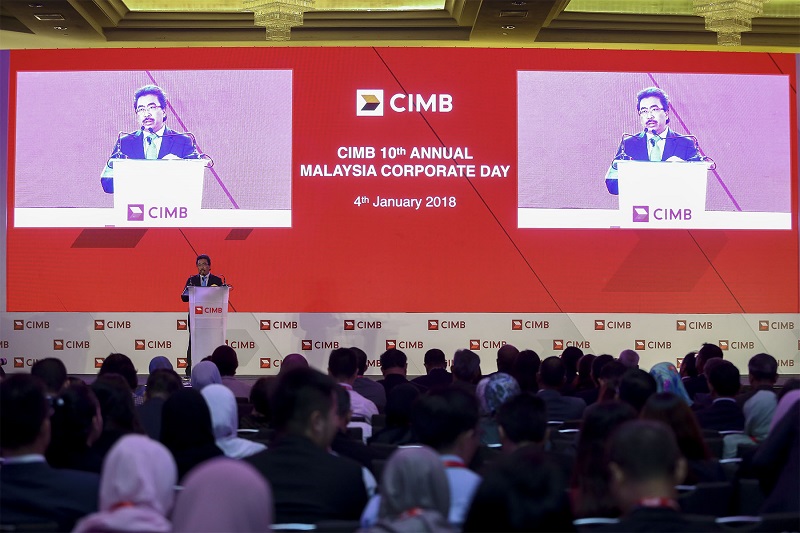
4 January 2018 : CIMB 10TH Annual Malaysia Corporate Day, Kuala Lumpur